
Drainage Systems in
Montgomery CountySite hydrology and septic-aware drainage across the county
Montgomery County drainage spans every condition we work with — Piney Woods forest drainage in wooded Conroe, flat-prairie engineering on the western edges near Magnolia, lake-adjacent systems around Lake Conroe, and full site hydrology on the acreage properties that dominate the unincorporated portions of the county. Septic coexistence, county-level permitting, and large-scale water paths make most Montgomery County drainage projects more complex than equivalent work in urban Houston markets.
What makes Montgomery County drainage different
Montgomery County has three distinct drainage sub-markets. The eastern side around Conroe and the Woodlands edge has dense canopy, expansive clay, and a mix of HOA-governed and unincorporated lots — drainage here looks much like Woodlands drainage with similar root-work protocols. The central Spring Creek corridor has more mixed terrain with transitional soil conditions. The western Magnolia area transitions into prairie with larger rural lots, more surface drainage, and less canopy. Each sub-market requires its own engineering approach.
The septic and well factor applies across the whole county and is the single biggest differentiator from Harris County drainage work. Most Montgomery County properties outside incorporated cities have private septic systems and often private wells — both of which impose hard constraints on where drainage can be routed. Septic drain fields need surface permeability and minimum clearances from impermeable installations; wells require specific setbacks from potential contamination paths. An experienced Montgomery County contractor maps both before designing drainage; inexperienced ones create septic failures or contaminated wells as collateral damage.
Our Montgomery County drainage approach
Every Montgomery County project begins with a full site survey — soil, topography, septic, well, trees, existing drainage, and outlet options — because the engineering requirements vary so much across the county.
Full-site hydrological survey
Before design, we map topography, soil conditions, septic and well locations, tree canopies, and available discharge outlets.
Septic-aware design
Drainage paths maintain required clearances from septic tanks, drain fields, and lateral lines — a hard constraint on every project with private septic.
County permit coordination
Montgomery County Precinct-level permits for driveway culverts, flood-plain work, and ROW connections are pulled as part of the project.
Sub-market appropriate design
Wooded Conroe projects use Woodlands-style root-aware drainage; Magnolia acreage uses site-scale swales and culverts; master-planned communities use engineered French drains with community-system integration.
On-site retention where required
Properties without clear downstream outlets get engineered retention features that manage peak flows rather than exporting problems.
Multi-phase programs
Large estates often phase drainage work across multiple seasons — each phase is designed to tie into future phases without rework.
Areas we serve in Montgomery County
Our Montgomery County drainage work covers the county from Conroe to Magnolia, including both HOA-controlled master-planned communities and unincorporated acreage properties.
Conroe / April Sound
Lake-adjacent drainage with coordinated community and lot-level systems.
Woodforest
Master-planned community; standard HOA-approved discharge plans.
Magnolia / FM 1488 corridor
Rural acreage with site-scale hydrology work common.
Imperial Oaks
Transitional market; mix of retrofit and new drainage scopes.
Spring Creek corridor
Wooded lots with Woodlands-style root-aware drainage.
Grand Central Park (Conroe)
Newer master-planned community with modern drainage specs.
Lake Conroe communities
Lake-adjacent properties with specialized waterfront drainage requirements.
Porter / New Caney edges
Large rural lots with long driveways and full site-drainage programs.
A recent Montgomery County project
A 5-acre Magnolia-area property had chronic flooding of a barn and workshop area at the low point of the lot, combined with backed-up water around the septic drain field after heavy rains. The previous contractor had installed a French drain that discharged directly onto the drain field — accelerating septic saturation rather than solving the flooding.
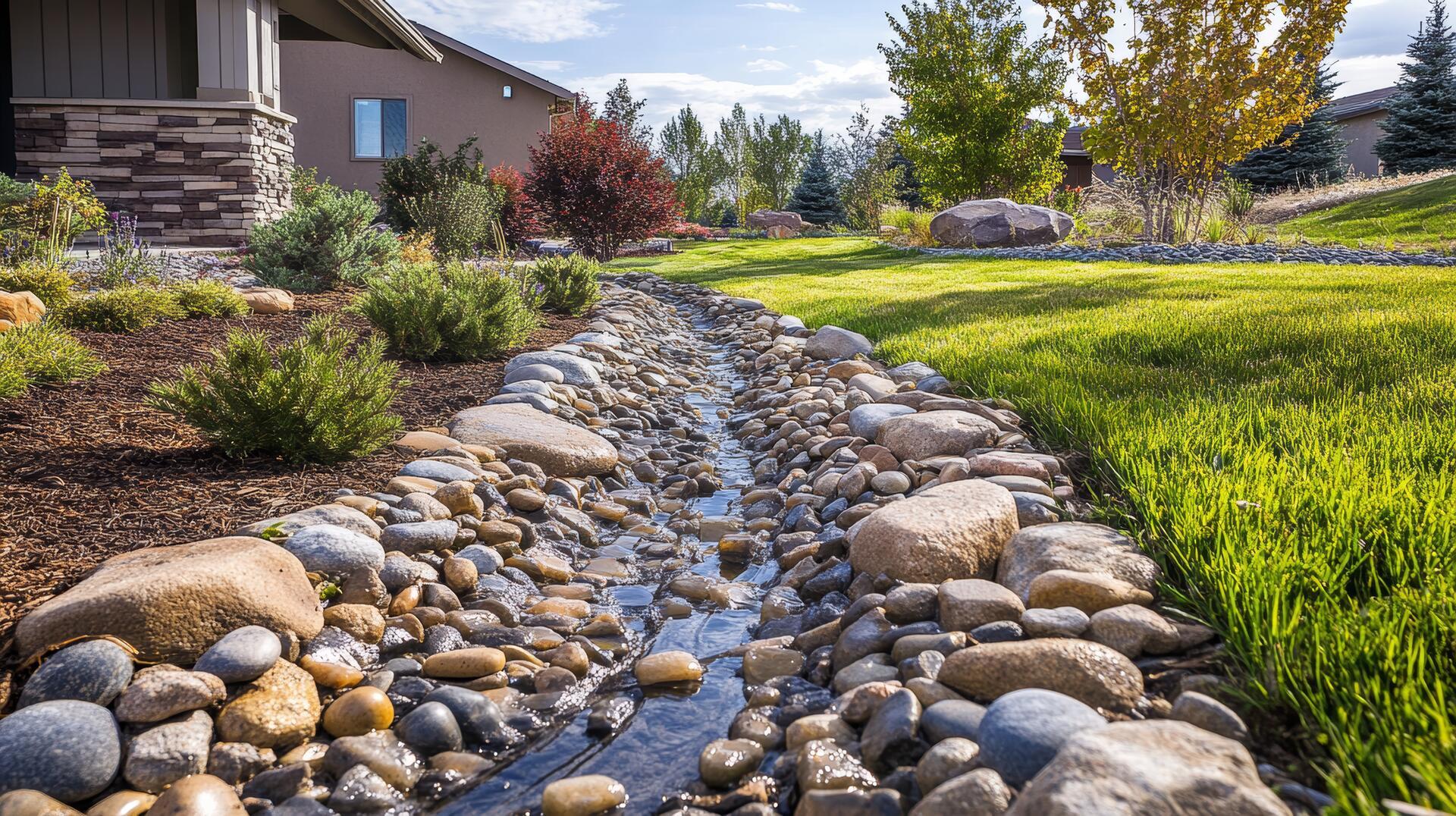
We redesigned the drainage as a full site-scale system: a crowned swale carrying upstream water diagonally around the structures rather than through them, a stone-lined dry creek bed running along the eastern property boundary to the county ditch, and a complete re-routing of the original French drain discharge to the new dry-creek-bed outlet (well clear of the septic field). The barn and workshop have stayed dry through two subsequent wet seasons, and the septic is operating normally again.
What Montgomery County drainage projects cost
Project budgets span a wide range because the county's drainage conditions vary so dramatically — a focused drainage fix (single French drain, culvert replacement, specific wet-spot correction) is a fundamentally different project than a full site-scale hydrology program on an acreage property, or a lake-adjacent installation with specialized engineering. Projects start at $2,500. Every Montgomery County estimate includes a full on-site survey because the scope depends entirely on conditions that need to be assessed in person.
Montgomery County
Footprint.
We install drainage systems projects across Montgomery County and the surrounding North Houston corridor. Schedule a free on-site consultation by calling (713) 447-3398 or requesting a quote online.
Drainage Systems in Montgomery County
Questions Answered.
Can you install drainage without damaging my private septic system?
Yes — septic-aware design is standard on every Montgomery County project with private septic. We locate the tank and drain field (typically working with records or a septic pump-out service to verify layout), maintain minimum clearances from all septic components, and design drainage paths so that no water is concentrated onto the drain field. Failures in this area are among the most expensive mistakes in Montgomery County drainage work, which is why we treat septic location as a hard design constraint rather than an afterthought.
Do Montgomery County unincorporated drainage projects need permits?
It depends on the project. In-yard drainage that stays on your property and doesn't connect to county ROW generally doesn't require a permit. Drainage connecting to a county road ditch or shared easement, work in a mapped flood plain, and driveway culvert installations all require Precinct-level permits. We research the specific requirements for every project and pull the permits as part of the project scope where they apply.
What's different about drainage on a Lake Conroe or waterfront property?
Waterfront properties have additional considerations: higher water tables that make French drain outlet placement more complex, specific rules from the San Jacinto River Authority or lake governance about discharge to the lake, and seasonal water level changes that affect drainage capacity. We design waterfront drainage with elevated outlets, backflow protection, and coordination with lake-governance rules — a different spec than typical inland drainage.
How do you handle drainage on properties without a downstream outlet?
On-site retention. Montgomery County has a significant number of rural acreage properties where there's no legal or practical downstream outlet — no county ditch nearby, neighbors downstream who can't accept discharge, or environmental restrictions that prevent exporting water. For these properties, we design engineered retention features (dry wells, detention ponds, large-capacity infiltration beds) that hold peak flows and release water slowly enough for the soil to absorb. It's more complex than discharge drainage but is the only legal option in many cases.
Will drainage work disrupt my Magnolia or Conroe acreage landscape?
Less than most homeowners expect. Even site-scale drainage programs typically disturb a narrow trench line or swale path rather than large open areas. We use narrow-trench equipment, protect adjacent plantings, and restore the surface with re-sod, mulch, or dry-creek-bed finish as part of the project scope. Dry-creek-bed and swale features often become aesthetic landscape features rather than visible drainage infrastructure — once planted out, most homeowners forget they're drainage at all.
Drainage Systems Guides for Montgomery County Homeowners
French Drain Installation in Spring, TX: Cost, Process & What Homeowners Should Know in 2026
If your Spring, TX yard stays soggy long after the rain stops, a French drain is usually the right fix — but only if it is installed correctly on Beaumont Clay. Here is exactly what the installation involves, what it costs, and what separates a 30-year system from one that fails in five.
Read Guide ArticleHow to Know If You Need a French Drain in Spring, TX: 9 Signs to Watch For
If your yard stays wet for days after a storm, water pools against your foundation, or you have started seeing hairline cracks in your brick, those are not separate problems — they are the same problem in three forms. Here are the 9 signs your Spring, TX home needs a French drain.
Read Guide ArticleFrench Drain vs. Sump Pump in Houston Clay Soil: Which Does Your Spring, TX Home Need?
French drains and sump pumps solve overlapping problems and homeowners often confuse them. Here is exactly when you need a French drain alone, when a sump pump becomes mandatory, and when you need both — specifically for Houston-area clay soil and flat lots.
Read Guide ArticleFrench Drain vs. Surface Drain: Which Drainage Solution Does Your Spring, TX Home Need?
Standing water after a rainstorm is more than a nuisance in Spring, TX — it is a foundation threat. Here is how to choose the right drainage system for your property.
Read Guide ArticleWhy French Drains Fail on Beaumont Clay (and How to Spot a Bad Install Before You Pay for It)
French drains are supposed to last 30 to 50 years. The ones we get called out to repair almost always failed in five — and the failures are predictable. Here are the 6 reasons French drains fail on Beaumont Clay and the questions to ask any contractor before you sign.
Read GuideDrainage Systems in Nearby Areas
More From Us in Montgomery County
All Drainage Systems Services
See how we design, engineer, and install drainage systems projects across all six of our North Houston service areas.
View Hub ExploreAll Services in Montgomery County
Full landscape service menu for Montgomery County — drainage, hardscape, irrigation, outdoor living, and more.
View Montgomery County