
Drainage Systems in
The WoodlandsHidden, root-safe drainage for forested estates
Drainage in The Woodlands is a different engineering problem than drainage anywhere else in the Greater Houston area. The dense pine and oak canopy produces enormous volumes of leaf and needle litter that can clog any system not designed to reject debris, and the aggressive surface-root systems of mature trees make trench routing a careful, root-by-root process rather than a straight dig. Every system we install here is designed to be invisible in the finished landscape and to keep working through decades of canopy debris.
What's unique about Woodlands drainage
The Woodlands' forested character produces three conditions no other market shares in combination. First, expansive clay soil that holds water long after the rain has stopped. Second, dense canopy debris — pine needles, oak leaves, moss, seed pods — that relentlessly clogs any surface grate. Third, mature tree root systems that treat any trench as a potential resource and will grow into improperly protected drain lines within a few seasons.
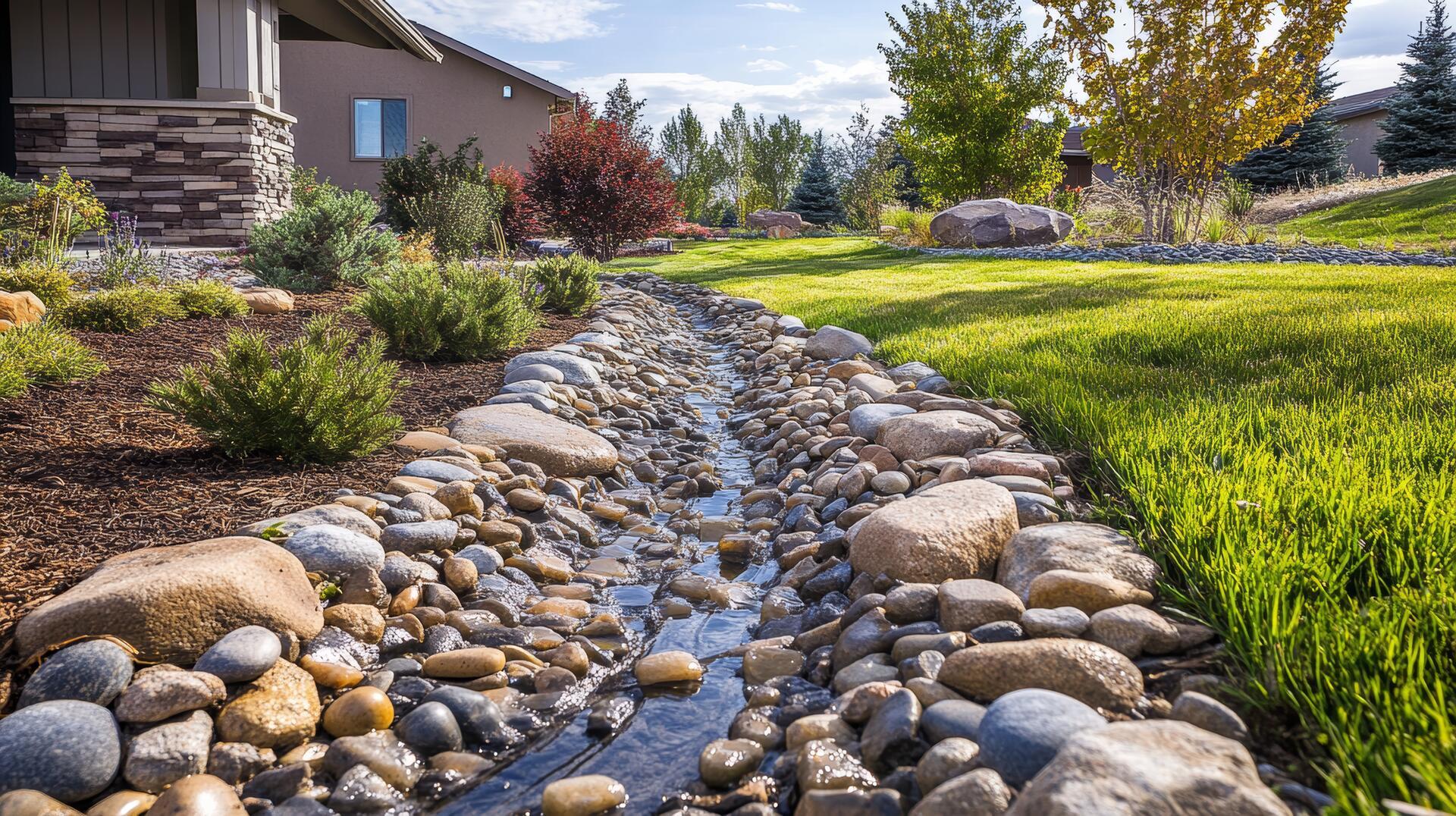
Standard French drains from the 1990s failed in The Woodlands for exactly these reasons. Our current spec uses larger 6" perforated pipe wrapped in non-woven filter fabric, set in a river-rock envelope with an engineered distance from major tree trunks, and capped with either naturalistic dry-creek-bed river rock or an ornamental planting bed to conceal the surface. Surface drains use heavy-duty cast-iron grates with debris boxes that can be cleaned twice a year rather than lightweight plastic grates that clog instantly under pine canopy.
Our Woodlands drainage approach
Every Woodlands drainage project is engineered around tree-root protection, debris rejection, and long-term concealment in the landscape.
Hydrological site survey
Before design, we map water entry points, grade, tree canopies, and existing drainage infrastructure — the survey is the single most important step.
Root-zone-aware trench routing
Trenches are routed around critical tree roots using hand-probing; critical roots get bridged rather than cut.
Premium spec French drains
6" perforated pipe, non-woven filter fabric envelope, coarse river-rock backfill — built to handle Gulf rainfall volumes without silting up.
Debris-rejecting surface drains
Cast-iron grates with debris boxes rather than plastic grates that clog under canopy; every surface drain gets a planned annual cleanout.
Invisible-in-landscape design
French drain outlets concealed under river-rock dry creek beds, mulched planting beds, or architectural stone so the finished landscape looks intentional.
Approved outlet routing
Every system discharges to a proper outlet — village storm system, ditch, or engineered dry well — never just "out there."
Villages we serve in The Woodlands
Drainage conditions vary significantly from village to village — and our approach varies with them.
Carlton Woods
Estate-scale drainage master plans; full yard systems are standard.
Grogan's Mill
Original village — original 1970s drainage is failing and in active replacement.
Panther Creek
Sloped lots with natural drainage patterns; design works with the topography.
Creekside Park
Newer community but flat lots still pond; modern engineered systems common.
Indian Springs
Dense mature canopy dictates root-aware trench routing.
Sterling Ridge
Larger lots support full lot-drainage programs including retaining and swales.
Cochran's Crossing
Mature village with aging original drainage — retrofit specialty.
A recent Woodlands project
A Panther Creek homeowner had water moving from the neighbor's slope into the side of their house after every moderate rainfall. Previous contractors had installed two separate surface drains that clogged within weeks from leaf and needle fall and stopped working entirely within a season.
We replaced the failed system with a 65-foot French drain set 8 feet off the foundation, routed around three major oak roots (two bridged, one protected with a root-cap geomembrane), and discharged into a river-rock dry creek bed running along the east property line that ties into the village storm inlet. The system has been continuously working through three rainy seasons with only an annual debris-box cleanout.
What drainage projects cost in The Woodlands
Woodlands drainage budgets reflect the root-work and premium spec requirements common in the area. Projects start at $2,500. Every quote is provided after an on-site survey because the tree and grade conditions vary too much to price accurately over the phone.
The Woodlands
Footprint.
We install drainage systems projects across The Woodlands and the surrounding North Houston corridor. Schedule a free on-site consultation by calling (713) 447-3398 or requesting a quote online.
Drainage Systems in The Woodlands
Questions Answered.
Will a French drain damage the mature trees on my Woodlands property?
Not when installed properly. Our Woodlands protocol for drainage work near mature trees includes hand-probing to locate critical roots before trenching, root bridging rather than cutting for roots larger than 2 inches, and root-cap geomembranes for root zones that must be crossed. Following these protocols, we've had no tree loss attributable to drainage work on our Woodlands projects. The larger risk is actually letting water continue to damage a tree — chronic saturated soil is one of the leading causes of tree decline in the area.
How often does a Woodlands French drain need maintenance?
The drain pipe itself, when properly specified with filter fabric and coarse backfill, should require no maintenance for 20+ years. The surface components — any grates or catch basins — need a cleanout twice a year in The Woodlands because of the canopy debris. Most of our Woodlands systems are designed with accessible debris boxes specifically to make that twice-yearly cleanout a five-minute task rather than a major service call.
Can you route a drain without cutting down trees in my Woodlands yard?
In nearly every case, yes. Root-aware trench routing is one of the fundamental skills of working in this market. We hand-probe ahead of every trench to locate significant roots, and design the trench path to avoid critical root zones whenever possible. For specimen trees or trees the village wants preserved, we coordinate with certified arborists on approach. We've run drainage around — not through — hundreds of mature Woodlands trees.
Does my village require a permit for drainage work?
Most Woodlands villages do not require a permit for a standard residential French drain or surface drain, but work that discharges into the village storm system, crosses property lines, or requires excavation within ARC-protected tree zones does require village-level approval. We handle the submissions as part of any project that needs them, and we coordinate with the WCA or the village ARC directly rather than leaving that burden on you.
Why does water pool in the low spots of my Woodlands yard even though the village has storm drainage?
Community-level storm drainage is designed to handle street runoff, not individual lot surface water. Lot-level drainage from your yard to the community system is the homeowner's responsibility, and many Woodlands lots — especially older village builds — were graded to minimum specification with no engineered path from the yard to the storm inlet. Water sits in the low spots until it slowly soaks in or evaporates. A residential French drain or surface drain that explicitly connects your yard to the nearest village storm outlet is the standard solution.
Drainage Systems Guides for The Woodlands Homeowners
French Drain Installation in Spring, TX: Cost, Process & What Homeowners Should Know in 2026
If your Spring, TX yard stays soggy long after the rain stops, a French drain is usually the right fix — but only if it is installed correctly on Beaumont Clay. Here is exactly what the installation involves, what it costs, and what separates a 30-year system from one that fails in five.
Read Guide ArticleHow to Know If You Need a French Drain in Spring, TX: 9 Signs to Watch For
If your yard stays wet for days after a storm, water pools against your foundation, or you have started seeing hairline cracks in your brick, those are not separate problems — they are the same problem in three forms. Here are the 9 signs your Spring, TX home needs a French drain.
Read Guide ArticleFrench Drain vs. Sump Pump in Houston Clay Soil: Which Does Your Spring, TX Home Need?
French drains and sump pumps solve overlapping problems and homeowners often confuse them. Here is exactly when you need a French drain alone, when a sump pump becomes mandatory, and when you need both — specifically for Houston-area clay soil and flat lots.
Read Guide ArticleFrench Drain vs. Surface Drain: Which Drainage Solution Does Your Spring, TX Home Need?
Standing water after a rainstorm is more than a nuisance in Spring, TX — it is a foundation threat. Here is how to choose the right drainage system for your property.
Read Guide ArticleWhy French Drains Fail on Beaumont Clay (and How to Spot a Bad Install Before You Pay for It)
French drains are supposed to last 30 to 50 years. The ones we get called out to repair almost always failed in five — and the failures are predictable. Here are the 6 reasons French drains fail on Beaumont Clay and the questions to ask any contractor before you sign.
Read GuideDrainage Systems in Nearby Areas
More From Us in The Woodlands
All Drainage Systems Services
See how we design, engineer, and install drainage systems projects across all six of our North Houston service areas.
View Hub ExploreAll Services in The Woodlands
Full landscape service menu for The Woodlands — drainage, hardscape, irrigation, outdoor living, and more.
View The Woodlands