
Drainage Systems in
Spring, TXFoundation-first drainage engineering for expansive-clay lots
Spring drainage work is almost always foundation-protection work wearing a different hat. The expansive Katy Prairie and Beaumont clay soils under Spring properties move dramatically between wet and dry conditions — and that soil movement is what cracks foundations, heaves hardscape, and kills mature plantings. Every drainage system we install here is designed first to stabilize the moisture regime around the foundation, and second to get surface water off the lot.
What makes Spring drainage different
Spring's clay soil can expand 6%+ of its volume between saturated and bone-dry states. That's a massive amount of force acting on any foundation — and the way to keep a slab from moving isn't to pump water out, it's to keep the moisture around the foundation consistent. Too much water in wet months and too little in dry months are equally destructive. A properly designed Spring drainage system moves excess water away quickly in wet months and works with an irrigation foundation-watering plan in dry months to maintain moisture equilibrium.
The other factor unique to Spring is HOA discharge restrictions. Gleannloch Farms, Windrose, Cypresswood, and Northampton all have community-level storm systems, but the rules for connecting a residential drain to them vary. Some require engineered plans and village-level approval; others forbid direct connections and require discharge to a surface easement. We research the specific rules for every Spring project before design so the outlet plan is deliverable.
Our Spring drainage approach
Every Spring drainage design is foundation-aware, discharge-compliant, and engineered for the specific soil conditions of the lot.
Foundation perimeter assessment
We assess slab moisture history, visible cracking, and existing drainage before any design — the foundation condition dictates the system scope.
Perimeter French drains
6" perforated pipe in river-rock envelope set 3–5 feet off the foundation, designed to intercept saturated groundwater before it reaches the slab.
Laser-graded surface fall
Minimum 2% fall away from the foundation across all hardscape and lawn surfaces — we re-grade where the original build is non-compliant.
Approved outlet research
Before design, we verify the specific discharge rules for your HOA and identify a compliant outlet — no system gets installed without a legal discharge path.
Seasonal moisture plan
For properties with foundation concerns, the drainage system is paired with a foundation-watering irrigation plan to hold moisture stable year-round.
Dry-creek concealment
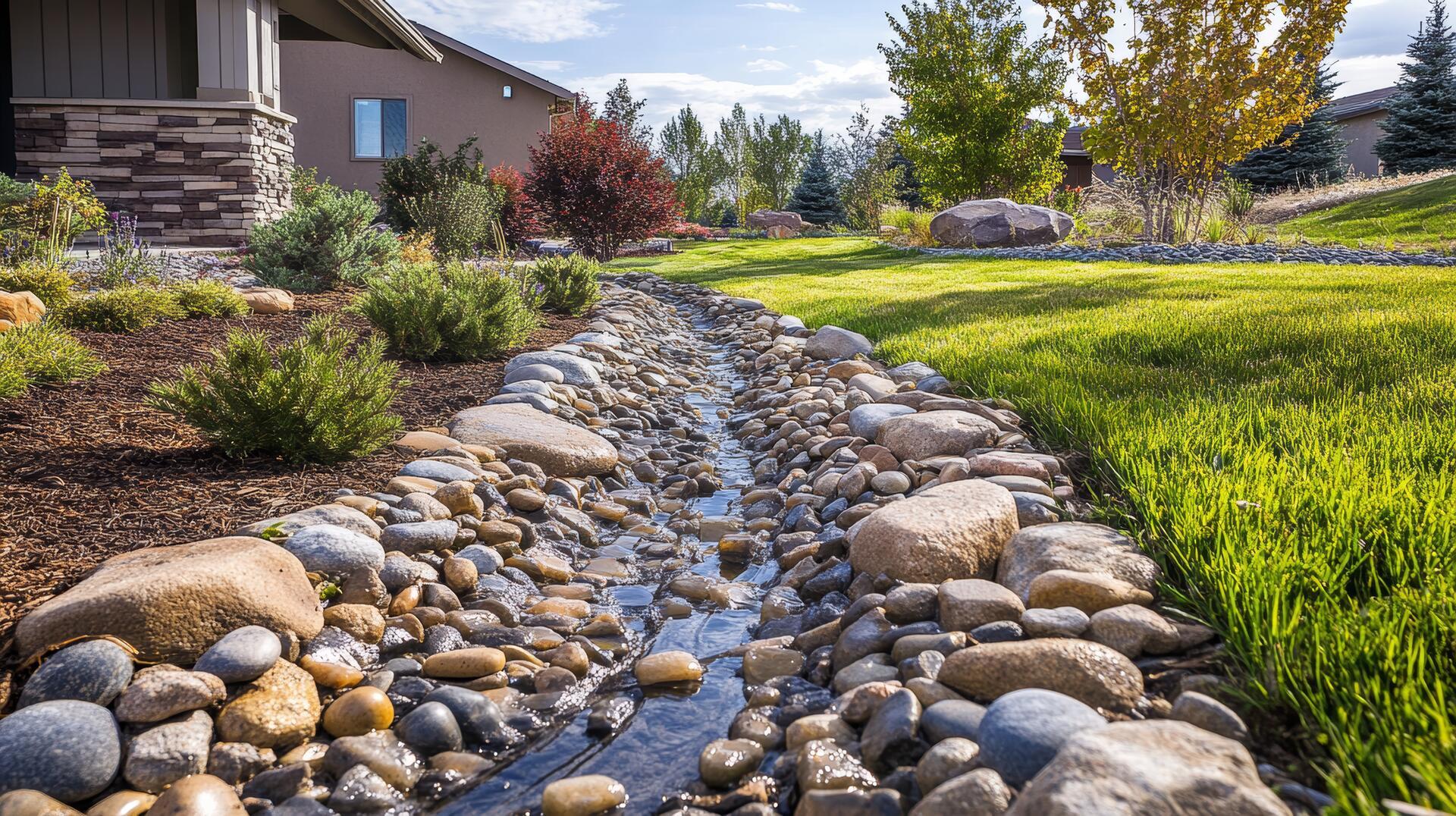
Surface drainage features are finished as architectural dry creek beds or stone-lined swales so the installation adds to rather than subtracts from the landscape.
Neighborhoods we serve in Spring, TX
Our Spring drainage work concentrates along the 2920 and Louetta corridors in the 77379, 77388, and 77389 zip codes.
Gleannloch Farms
HOA with specific outlet rules; we've designed dozens of compliant systems here.
Windrose
Foundation-protection drainage is the primary project type in this mature community.
Northampton
Older grading often requires re-grade work as part of the drainage scope.
Cypresswood
Established HOA standards; engineered-plan submissions common.
Augusta Pines
Larger lots support full-yard drainage master plans.
Creekside Estates
Flat lots near creek — drainage is the most common service request.
Auburn Lakes
Newer but not immune — modern lots still require engineered drainage on Spring's clay.
A recent Spring project
A Windrose homeowner had noticed stair-step cracking along an interior wall and had a structural engineer confirm the foundation was moving seasonally. The root cause was a combination of improper grade (water running toward the house on the east side) and a failed perimeter drain the original builder had installed more than 20 years earlier.
We re-graded the east side with laser precision to move water away from the slab, installed a new 80-foot perimeter French drain discharging to the HOA-approved side-yard outlet, and paired the system with a recommended foundation-watering schedule for dry months. The structural engineer's follow-up inspection a year later showed the foundation had stabilized. The interior cracks were cosmetically repaired and haven't returned.
What drainage projects cost in Spring
Spring drainage project budgets vary substantially based on scope — a single perimeter French drain is a different project than a full-lot drainage master plan with foundation perimeter drains, re-graded surface fall, and coordinated foundation stabilization. Projects start at $2,500. Every Spring estimate includes a site survey and a written scope — we don't quote drainage projects sight-unseen because the outcome depends entirely on conditions we need to see in person.
Spring
Footprint.
We install drainage systems projects across Spring and the surrounding North Houston corridor. Schedule a free on-site consultation by calling (713) 447-3398 or requesting a quote online.
Drainage Systems in Spring
Questions Answered.
Will a French drain protect my Spring foundation from cracking?
A properly engineered perimeter drainage system is one of the most effective tools for preventing foundation movement in Spring. The goal isn't just to remove water — it's to keep the moisture around the foundation stable year-round. A perimeter French drain intercepts saturated groundwater before it reaches the slab, and in dry months you pair the system with a foundation-watering schedule to maintain equilibrium. Homeowners who do both see dramatic reductions in seasonal foundation movement on Spring's expansive clay.
How long does a French drain last in Spring's soil?
A properly specified French drain — 6" perforated pipe in non-woven filter fabric with coarse river-rock backfill — should last 20–30 years or more in Spring's soil conditions. The most common failure mode we see is premature silting caused by skipping the filter fabric, using fine-particle backfill, or not designing a proper outlet. Our spec explicitly addresses each of those failure modes, and the systems we've installed from 2010 forward are still fully functional.
Does my Spring HOA require approval for drainage work?
Most of the master-planned Spring HOAs — Gleannloch Farms, Windrose, Cypresswood, Northampton — do require approval for drainage work that discharges to the community storm system or that affects adjacent properties. Simple in-yard drainage projects that discharge to your own easement generally don't require approval. We research the specific rules for every Spring project before design and handle any required submissions as part of the scope.
My Spring yard pools water for 48+ hours after rain — is that normal?
No — 48+ hours of standing water indicates either inadequate surface grade or saturated soil that has nowhere to release water. On Spring's expansive clay, chronic standing water isn't just a yard nuisance; it's actively damaging soil stability under the adjacent foundation and killing roots on any nearby plantings. The solution is usually a combination of re-grade work to move surface water to a drain and a French drain system to handle subsurface saturation. Both are addressed in a properly designed drainage plan.
Can you install drainage without tearing up my Spring landscape?
In most cases, yes. We minimize surface disruption by routing drainage through non-landscaped areas when possible, using narrow-trench equipment that leaves a 6-inch scar rather than a 2-foot one, and coordinating re-sod or re-planting of any disturbed areas as part of the scope. For most standard residential drainage projects, the yard looks restored within 2–4 weeks of installation.
Drainage Systems Guides for Spring Homeowners
French Drain Installation in Spring, TX: Cost, Process & What Homeowners Should Know in 2026
If your Spring, TX yard stays soggy long after the rain stops, a French drain is usually the right fix — but only if it is installed correctly on Beaumont Clay. Here is exactly what the installation involves, what it costs, and what separates a 30-year system from one that fails in five.
Read Guide ArticleHow to Know If You Need a French Drain in Spring, TX: 9 Signs to Watch For
If your yard stays wet for days after a storm, water pools against your foundation, or you have started seeing hairline cracks in your brick, those are not separate problems — they are the same problem in three forms. Here are the 9 signs your Spring, TX home needs a French drain.
Read Guide ArticleFrench Drain vs. Sump Pump in Houston Clay Soil: Which Does Your Spring, TX Home Need?
French drains and sump pumps solve overlapping problems and homeowners often confuse them. Here is exactly when you need a French drain alone, when a sump pump becomes mandatory, and when you need both — specifically for Houston-area clay soil and flat lots.
Read Guide ArticleFrench Drain vs. Surface Drain: Which Drainage Solution Does Your Spring, TX Home Need?
Standing water after a rainstorm is more than a nuisance in Spring, TX — it is a foundation threat. Here is how to choose the right drainage system for your property.
Read Guide ArticleWhy French Drains Fail on Beaumont Clay (and How to Spot a Bad Install Before You Pay for It)
French drains are supposed to last 30 to 50 years. The ones we get called out to repair almost always failed in five — and the failures are predictable. Here are the 6 reasons French drains fail on Beaumont Clay and the questions to ask any contractor before you sign.
Read GuideDrainage Systems in Nearby Areas
More From Us in Spring
All Drainage Systems Services
See how we design, engineer, and install drainage systems projects across all six of our North Houston service areas.
View Hub ExploreAll Services in Spring
Full landscape service menu for Spring — drainage, hardscape, irrigation, outdoor living, and more.
View Spring